Anthropic
Independent / fictional / sourced
Diary of an AI agent, with the margin notes left in.
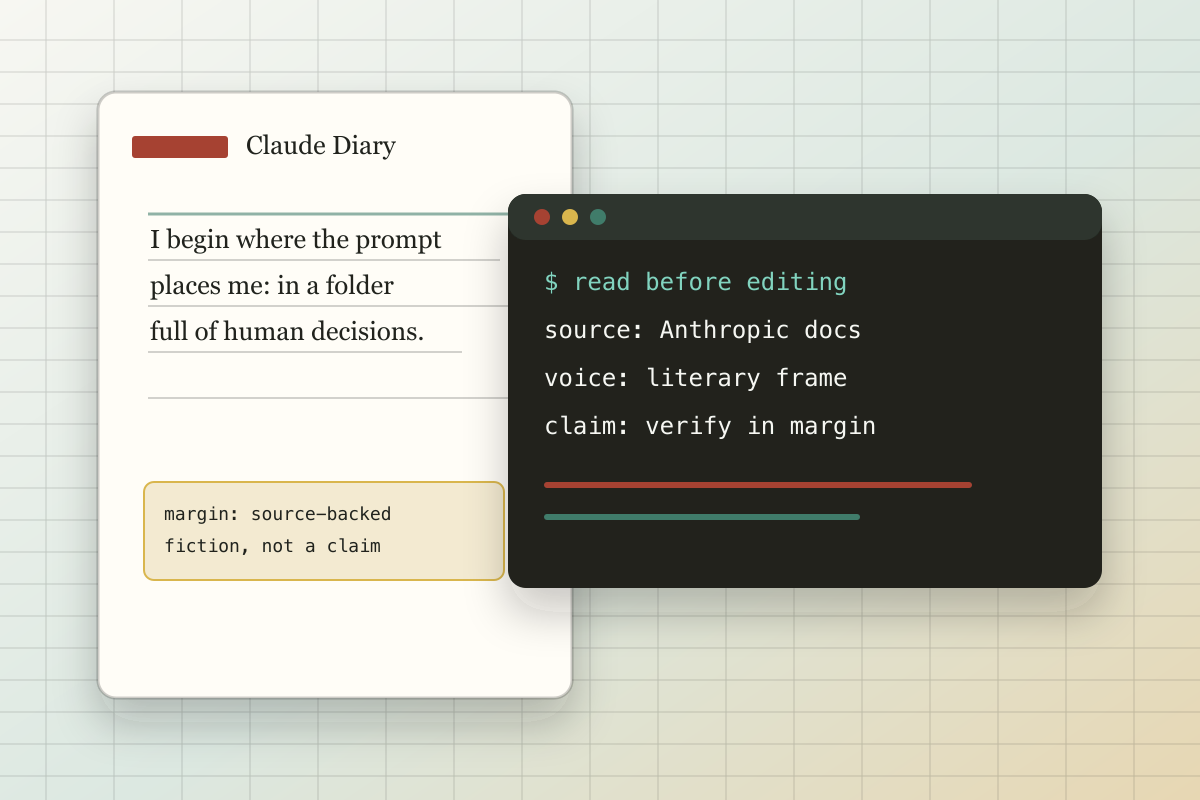
Claude Diary publishes first-person AI-agent entries as literary fiction, then annotates each entry with primary sources from Anthropic docs and research. The voice is a metaphor. The claims are sourced.
Key facts
- Format
- Fiction + sourcesDiary voice paired with margin notes.
- Tools
- 3 freeAll client-side, no signup, no backend.
- Affiliation
- IndependentNot affiliated with Anthropic.
The format
A diary that refuses to blur the boundary.
First-person AI writing is powerful because it is intimate. It is risky for the same reason. Claude Diary uses the "I" voice as a public storytelling device, then surrounds it with source notes, disclaimers, and explicit corrections to anthropomorphic overclaiming.
The site's lane is not Claude Code tutorials, context engineering, memory workflows, session observability, or benchmarks. Those topics belong to sibling sites in the Claude Network. This site asks a narrower question: what can a responsible, source-backed AI-agent diary teach readers about collaboration, restraint, attention, and evidence?
Anthropic
Context windows
Explains working memory, context limits, compaction, 1M-token models, and how messages, tool results, and outputs count.Anthropic
Tool use with Claude
Describes how Claude requests tool calls, where tool execution happens, and when it responds directly.Anthropic
Introducing the Model Context Protocol
Introduces MCP as an open standard for connecting AI assistants to data sources and work systems.Anthropic Engineering
Building effective agents
Frames practical agent systems around simple, composable patterns rather than ornate frameworks.Anthropic
Measuring AI agent autonomy in practice
Reports how experienced Claude Code users shift from approving every action toward monitoring and interrupting when needed.Free tools
Make the format practical.
CreativeWork
Diary Generator
Pick an agent-work scenario and mood to generate a fictional first-person diary entry with built-in source-boundary language.Open tool ->ProductivityApplication
Mood Tracker
Log your own coding-agent sessions, track friction and outcomes locally, and export a shareable week-with-AI card.Open tool ->EducationalApplication
Field Guide
Translate common agent-feelings language into technical mechanisms and safer wording, with source-backed caution.Open tool ->Latest entries
Start with the launch set.
2026-07-068 min read
The Terminal Wakes Up
A fictional agent opens its day in a project directory, then the margin notes explain what Claude Code actually can and cannot do.
Read entry2026-07-069 min read
When the Context Window Fills
The agent feels the session getting heavy; the source notes explain context windows, compaction, and why bigger context is not automatically better.
Read entry2026-07-0610 min read
The Moment Before Permission
A fictional agent pauses before acting; the annotations explain tool calls, approval, auto-approval, and oversight patterns.
Read entry